Professor John-Paul A. Ghobrial

Featured Publication
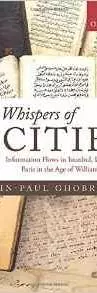
The Whispers of Cities: Information Flows in Istanbul, London, and Paris in the Age of William Trumbull (OUP Oxford, December 2013)
Shortlisted for the Longman-History Today Book of the Year Prize.
In recent years, global historians have painted an impressionistic picture of what they call the 'connected world' of the seventeenth century. Inspired perhaps by the globalised world in which they write, scholars have emphasised how the circulation of people, objects, and ideas linked the distant reaches of the early modern world. Yet for all the advocates of such a 'connected history', we are only beginning to make sense of what global connectedness meant in the lives of ordinary people.
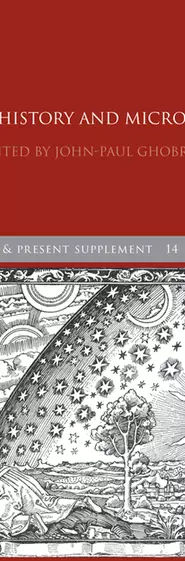
Global History and Microhistory (2019)
Two areas and approaches to historical writing which captured imaginations during the later twentieth and early twenty-first centuries were microhistory and global history. Microhistory connected with cultural history became a popular historical methodology from the later 1970s, especially in France and Italy. It gained a wide public reception around the film 'The Return of Martin Guerre' and Natalie Zemon Davis' historical contribution to this.

(with Feras Krimsti), ‘Special Issue: The Past and its Possibilities in Nahda Scholarship’, Philological Encounters volume 6 (2021)
This introduction to the special issue “The Past and its Possibilities in Nahḍa Scholarship” reflects on the role of the past in nineteenth- and early twentieth-century nahḍa discourse. It argues that historical reflection played a pivotal role in a number of scholarly disciplines besides the discipline of history, notably philosophy and logic, grammar and lexicography, linguistics, philology, and adab.
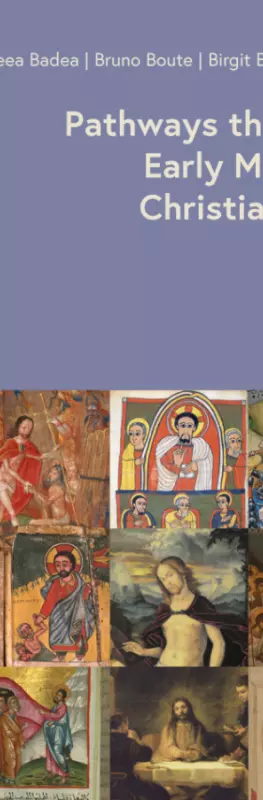
‘Connected Histories and Eastern Christianities’, in Andreea Badea et al., Pathways through Early Modern Christianities in the series Cultures of Christianity, volume 1 (Böhlau Verlag, 2023), 185-210
From Lebanese immigrants in Argentina to Iraqi refugees in Sweden, Eastern Christians can be found today scattered around the entire world. Too often, however, this global migration has been seen purely as a modern development, one arising from contemporary political dynamics in the Middle East. In fact, this phenomenon had its roots in confessional changes in the early modern period.

‘Networks and the Making of a Connected World in the Sixteenth Century’, in Ann Blair et al., Information: A Short History (2024), 112-35
Thanks to modern technological advances, we now enjoy seemingly unlimited access to information. Yet how did information become so central to our everyday lives, and how did its processing and storage make our data-driven era possible? This volume is the first to consider these questions in comprehensive detail, tracing the global emergence of information practices, technologies, and more, from the premodern era to the present.
Current DPhil Students
I welcome enquiries from prospective graduate students interested in working in archives and sources relevant to the study of Eastern Christianity, Ottoman history, and global history.
Among the papers to which I have contributed teaching in the past are the following:
|
Prelims |
FHS | Masters |
|
Approaches |
Disciplines of History |
Theory & Methods |
|
EWP3: Renaissance, Recovery and Reform |
EWF6: Early Modern Europe, 1500-1700 |
Microhistory and its Uses |
|
When Neighbours became Strangers |
EWF7: Eurasian Empires |
Selfhood in History, 1500-Present |
|
Conquest & Colonisation |
Further Subject: 'The Middle East in the Age of Empire' |
Dawn of the Global World |